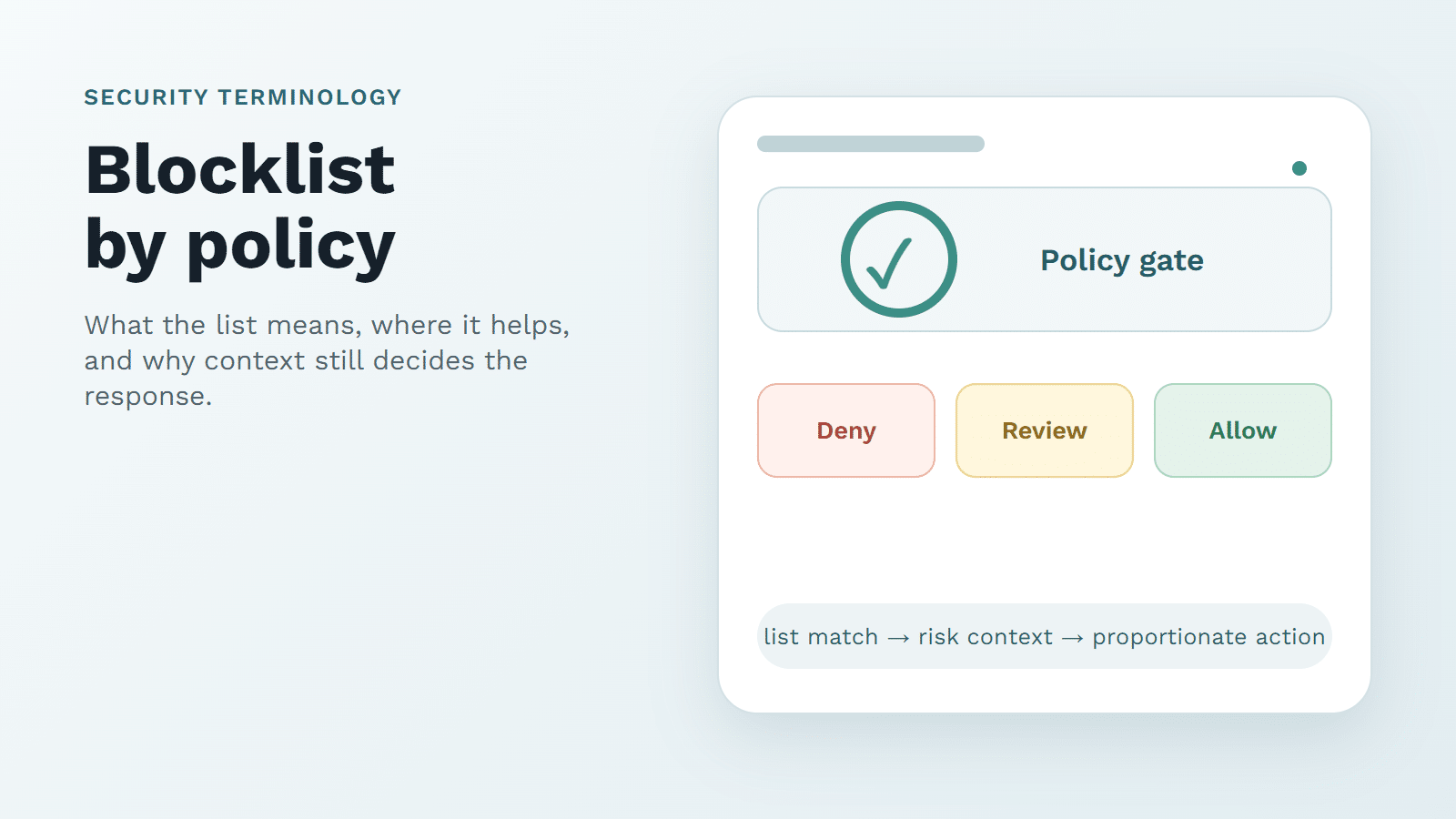

In cybersecurity, blacklist, blocklist, and denylist usually describe the same basic mechanism: a policy names entities that should be denied, restricted, or handled differently. The label alone does not tell you what is listed, who owns the decision, how long an entry remains valid, or what action follows a match.
That distinction matters in bot defense. A fast, deterministic list can stop known abuse with little processing, but the same rule can also block legitimate users behind shared infrastructure or miss an attacker who rotates identifiers. Security teams therefore need both accurate terminology and an operating model for using lists safely.
What a Blocklist Actually Does
A blocklist is a set of elements that a policy prevents from performing a defined action. The NIST Computer Security Resource Center uses a policy-based definition and notes that the concept was historically known as a blacklist. The crucial word is policy: the list stores entries, while an enforcement point decides what a match means.
1. A list is data; enforcement is a policy decision
An IP address, account ID, domain, file hash, or device identifier does nothing by itself. A web application, email gateway, API layer, endpoint product, or risk engine must compare an event with the list and apply an action. That action might be a hard denial, but it could also be a rate limit, step-up check, monitoring flag, or manual review.
This separation prevents a common design error: treating every match as equally certain and equally severe. An internally confirmed malicious account can justify a different response from an IP inherited from an external reputation feed.
2. Match quality and action severity are separate choices
Confidence comes from the source, freshness, object type, and context of an entry. Severity comes from the business action at risk. A match on a low-value content request may only warrant observation. The same signal during password reset, coupon redemption, or bulk account creation may justify tighter controls.
For each list, document both questions: “How much do we trust this match?” and “What is the least disruptive response that still protects this flow?”
If a match only adds context, triggers monitoring, or queues review without restricting an action, the collection is better described as a watchlist, indicator list, or risk list. A blocklist may feed a broader policy engine, but its defining role is to deny or restrict a named entity within a stated scope.
Blacklist, Blocklist, and Denylist Use Different Labels
The three terms are often synonyms, not universally standardized technologies. Modern documentation increasingly prefers blocklist or denylist. The UK National Cyber Security Centre, for example, explains its move toward allow list and deny list terminology. That is language guidance, not evidence that every product implements a denylist differently from a blocklist.
| Term | Practical meaning in many systems | What to verify |
|---|---|---|
| Blacklist | Historical label for a list of denied or restricted entities | Whether the term is retained in a legacy API, database field, or customer workflow |
| Blocklist | Common current label for a policy-based list whose entries trigger blocking or restriction | What objects it accepts and whether every match causes a hard block |
| Denylist | Another current label emphasizing an access-control decision | Whether “deny” is final or one option in a broader response policy |
1. Why terminology changed
Many organizations updated their language to make documentation more inclusive and more literal. Blocklist describes the outcome; denylist describes the policy decision. Teams migrating names should still check schemas, API contracts, monitoring rules, dashboards, runbooks, and customer-facing documentation so that a vocabulary change does not break an integration.
2. When a product defines its own distinction
A vendor or internal platform may assign narrower meanings—for example, reserving one label for externally supplied threat intelligence and another for locally managed exceptions. That convention can be useful inside the product, but it should not be presented as an industry-wide definition. Read the local schema and action semantics rather than inferring capability from the label.
Common Objects Security Teams Put on Lists
Security lists are not limited to IP addresses. The right object depends on the control surface and on how easily the identifier can change or be shared.
| Object | Typical owner or control point | Possible action | Main watch-out |
|---|---|---|---|
| IP address or network range | Network, WAF, API, or abuse team | Block, throttle, challenge, observe | Shared IPs, carrier NAT, VPNs, proxies, and address rotation |
| Domain, URL, or email address | Email, web filtering, trust and safety | Reject, quarantine, flag, review | Compromised legitimate infrastructure and look-alike variants |
| Account or user ID | Identity, fraud, or platform operations | Suspend, restrict, step up, review | Account takeover, appeals, and linked-account evidence |
| Device identifier | Fraud, account protection, or risk platform | Add risk, restrict, verify | Reinstallation, masking, shared devices, and privacy review |
| File hash or signature | Endpoint, malware, or content security | Quarantine or block execution | Small changes can produce a new hash |
| User-Agent or content pattern | Bot, API, moderation, or application team | Observe, restrict, route, review | Client-declared strings and simple patterns are easy to spoof |
1. Network and reputation objects
IP, domain, and email lists are useful because many enforcement points can evaluate them quickly. They are also indirect identity signals. One address can represent a household, company gateway, mobile carrier, or cloud service; one compromised domain can later be remediated. Good operations therefore pair the entry with a reason, source, timestamp, and scope.
2. Identity, device, and content objects
Account and device objects sit closer to a business event, but they carry their own recovery and privacy questions. File hashes are precise for known artifacts but brittle when the artifact changes. User-Agent strings and other self-declared fields are weak identity proof, especially when allowlisting trusted automation. The more changeable or shareable the identifier, the less suitable it is as the sole reason for a permanent denial.
Blocklist vs. Allowlist: Which Control Fits?
A blocklist starts from general access and names exceptions that should be denied. An allowlist starts from general denial and names entities that are permitted. Neither model is automatically safer; each moves the maintenance burden and the failure mode.
| Decision dimension | Blocklist | Allowlist |
|---|---|---|
| Default posture | Broad access, deny known or high-confidence entities | Deny by default, permit a small verified population |
| Best fit | Public flows with changing legitimate users and known-abuse signals | Admin paths, partner integrations, service accounts, tightly bounded systems |
| Main failure mode | Unknown or rotating abuse remains unseen; shared identifiers can cause false positives | Legitimate users or integrations are excluded when the permitted set is incomplete |
| Ownership question | Who confirms entries, expiry, exceptions, and rollback? | Who approves every new permitted entity and reviews the list for drift? |
The table is a starting point, not a universal answer. Choose the model that matches the size, stability, and verifiability of the permitted population.
Use a blocklist when the population of known-bad entities is manageable and most traffic should remain accessible. Use an allowlist for tightly bounded administrative paths, partner integrations, service accounts, or other environments where the authorized population is small and controlled. For public websites and consumer flows, a pure allowlist is usually impractical because legitimate users and devices are too diverse.
Before choosing either model, ask:
- Can the identifier be authenticated, or is it merely self-declared?
- Who approves additions, exceptions, and removals?
- What happens when an entry is wrong or stale?
- Does the policy fail open, fail closed, or move to review when the list service is unavailable?
- Is a hard decision necessary, or would monitoring, throttling, or verification reduce risk with less friction?
Where Static Lists Break Down
Static lists remain valuable for known, high-confidence abuse. Their weakness is not that they are “old”; it is that attackers and legitimate infrastructure change faster than an unmanaged list.
1. Stale entries and unknown threats
A list only recognizes what has already been recorded. New infrastructure, new accounts, and new attack patterns are invisible until another control detects them. At the same time, previously malicious infrastructure may be reassigned or remediated. Without expiry and review, a temporary signal becomes a permanent source of false positives.
Imported intelligence can add coverage, but it also imports another party’s observation window and confidence model. Security teams should know when an entry was observed, for which behavior, and whether that behavior maps to their own application.
2. Rotation, shared infrastructure, and context loss
Bots can rotate IP addresses, domains, accounts, devices, and headers. Residential proxies make a network identity look consumer-like, while carrier-grade NAT can place many legitimate users behind the same address. A hard IP block may therefore miss a distributed attack and penalize real customers at the same time.
Lists also flatten context. The same account, device, or network can behave normally on one endpoint and abuse another. The same automation may be an authorized crawler in one path and an unwanted scraper in another. A match is most useful when it joins behavioral, session, account, endpoint, and business context instead of replacing them.
Run List Matching Inside Risk-Based Bot Control
Treat list matching as one fast signal or policy input inside layered bot management. A mature control makes entries explainable and reversible, then connects match confidence to proportionate response.
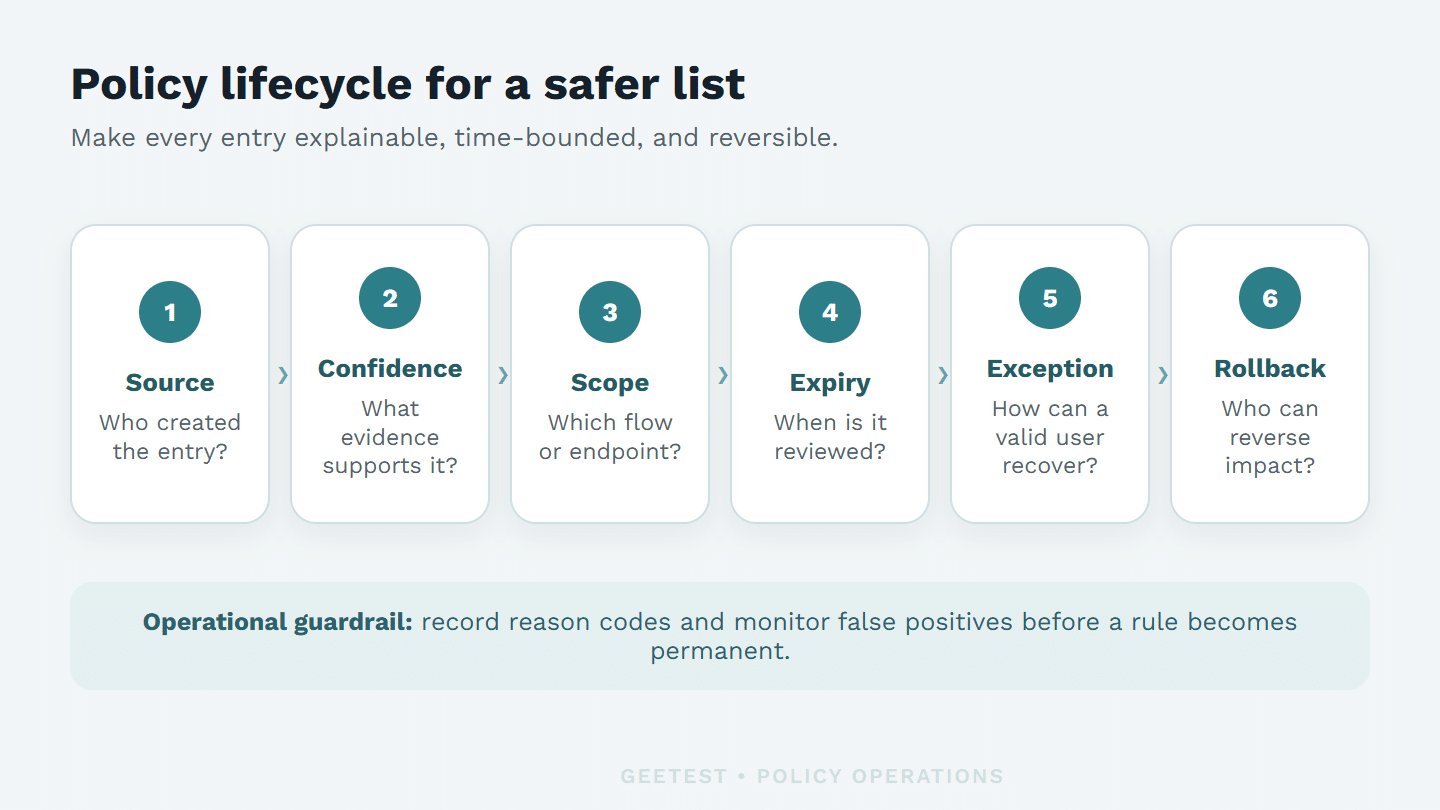
Give every operational list a minimum lifecycle:
- Source: who or what created the entry?
- Confidence: what evidence supports it, and for which behavior?
- Scope: which applications, endpoints, regions, or actions does it affect?
- Expiry: when should the entry be reviewed or removed?
- Reason code: can an analyst explain the decision consistently?
- Exception path: how can a legitimate user, partner, or service recover?
- Review and rollback: who monitors impact and can reverse the policy quickly?
1. Give every entry an owner and an expiry
Ownership turns a list from an accumulating file into a managed control. Shorter expiry may suit volatile IP or session signals; longer retention may suit a confirmed malicious file hash or closed fraudulent account. The exact period should follow evidence and business risk, not a universal schedule.
Monitor match volume, affected flows, exception rate, appeal or support signals, and the business effect of enforcement. A sudden change may indicate a new attack, a bad feed, a deployment error, or a legitimate network moving behind an address that was previously risky.
2. Connect matches to proportionate responses
The response should reflect both signal confidence and the cost of being wrong. Low-confidence events can be observed or rate-limited. Medium-risk events can receive step-up verification. High-confidence, high-impact abuse can be blocked, while ambiguous cases can go to review.
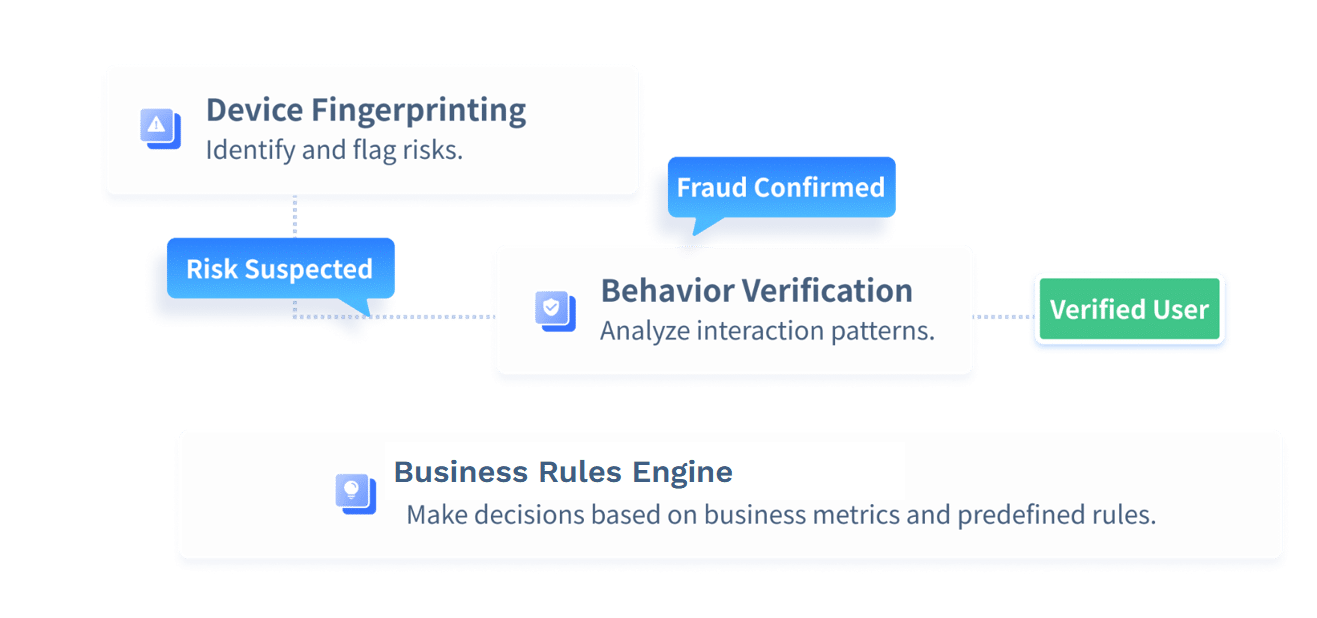
In a GeeTest deployment, device-risk signals can add context before enforcement, while policy orchestration can combine customer data, lists, counters, and rules. GeeTest Adaptive CAPTCHA can serve as a step-up verification option when a hard denial would create unnecessary friction. These roles are distinct: Business Rules Engine is not a static blacklist dashboard, and Device Fingerprinting does not make the final block decision by itself.
Operational Takeaway
Keep blocklists for known entities, but design expiry, exceptions, and layered signals around them. Use this framework to map sources, risk tiers, actions, and success measures. For anti-bot solutions, treat list matching as one signal, not the defense.
FAQ
1. Is a blacklist the same as a blocklist?
Usually, yes. In cybersecurity, both often describe a policy-based list of entities that are blocked or restricted. A particular product may define them differently, so check its documentation before assuming a technical distinction.
2. Is a denylist the same as a blocklist?
In many systems, the terms are interchangeable. Denylist emphasizes the access decision, while blocklist emphasizes the blocked set, but there is no universal rule that makes them different technologies.
3. Why are teams replacing the term blacklist?
Organizations are adopting more inclusive and descriptive language such as blocklist and denylist. A terminology migration should include APIs, schemas, monitoring, runbooks, and customer documentation—not only visible copy.
4. Can a blocklist stop bots by itself?
It can stop known bots or infrastructure represented by stable identifiers, but it will miss unknown or rotating identities and may create false positives on shared infrastructure. Stronger bot control combines lists with device, behavior, session, account, and business context.
5. When should a security team use an allowlist?
Use an allowlist when the permitted population is small, controlled, and verifiable, such as a partner integration or administrative path. Public user flows usually need broader access plus risk-based controls because a complete list of legitimate users and devices is not practical.