
Takeaways
1. Why do organizations need cyber defense?
To block automated attacks, protect critical actions, and reduce risk while keeping legitimate user interactions smooth.
2. What are core components of cyber defense?
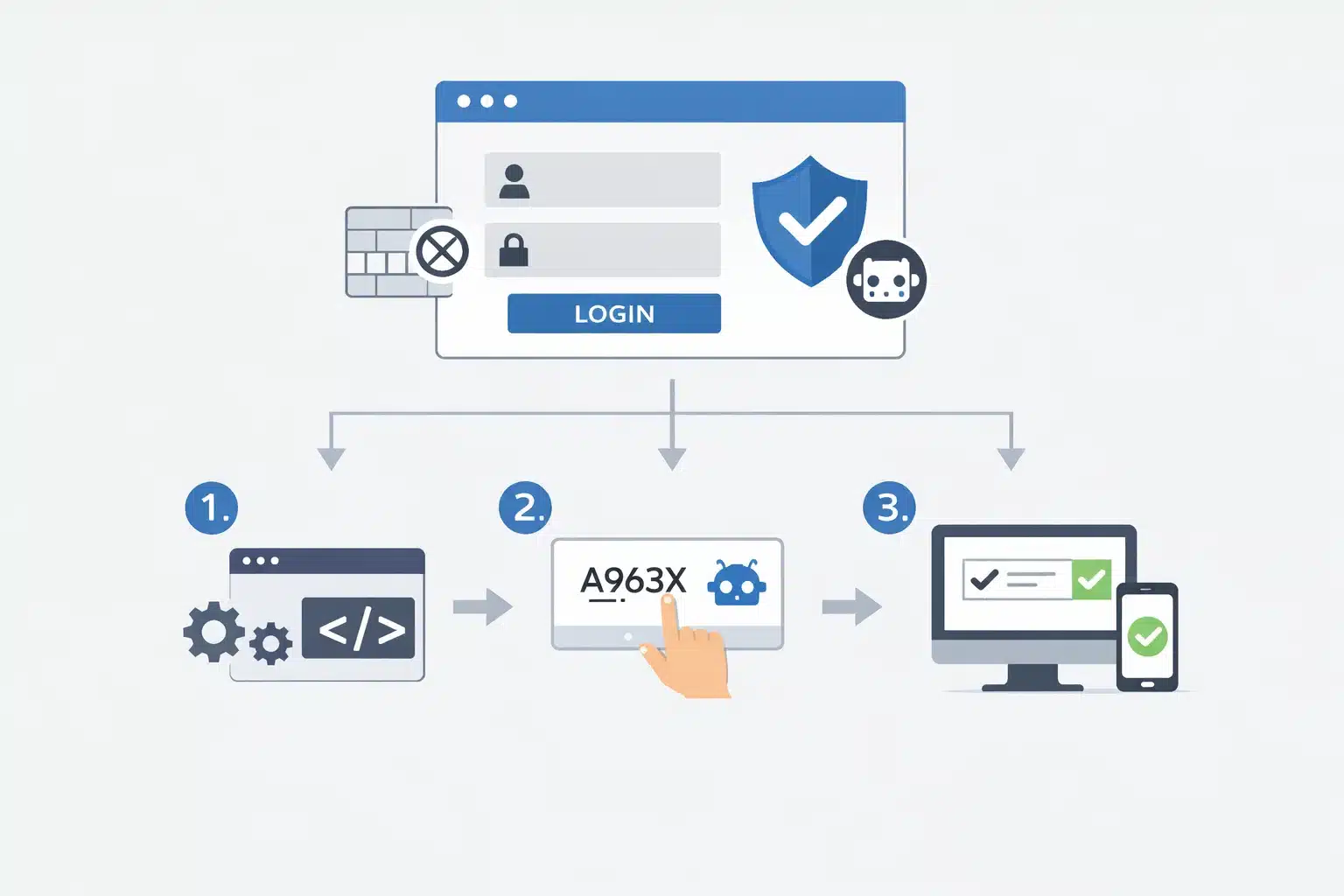
Protect entry points, collect signals, detect anomalies, assess risk, enforce controls, and continuously monitor and optimize.
3. How does modern cyber defense operate?
Secure high-risk surfaces, gather behavioral/device signals, assess risk contextually, apply adaptive controls, and refine via feedback.
4. How does cyber defense differ by industry?
SaaS, e-commerce, fintech, and gaming face unique threats; defense strategies must match traffic, attack types, and business workflows.
5. What is GeeTest’s role in cyber defense?
Provides Adaptive CAPTCHA, Device Fingerprinting, and Business Rules Engine for scenario-based verification and continuous optimization.
6. How to choose the right cyber defense solution?
Consider threat complexity, user experience, scalability, and scenario-specific risks; choose adaptive, integrated solutions.
Why Cyber Defense Matters More Than Ever
Cyber defense matters because digital systems have become central to how modern businesses operate—and increasingly attractive targets for attackers. As organizations rely more on cloud platforms, SaaS tools, APIs, and remote access, the potential attack surface continues to expand.
At the same time, cyber threats have evolved beyond simple malware or isolated hacks. Automated attacks, credential abuse, ransomware campaigns, and coordinated bot-driven activities now operate at scale, often targeting both large enterprises and smaller organizations. Traditional, reactive security measures struggle to keep pace with this shift.
In this environment, cyber defense is no longer about preventing a single breach. It is about building a continuous, adaptive capability to protect systems, detect threats early, respond effectively, and recover quickly when incidents occur.
What Is Cyber Defense?
Cyber defense is the practice of protecting digital systems, networks, applications, and data through continuous prevention, detection, response, and recovery against cyber threats.
Unlike point-in-time security controls, cyber defense focuses on ongoing protection and resilience. It combines technology, processes, and people to ensure that threats are not only blocked, but also identified, contained, and learned from.
A modern cyber defense approach typically includes:
- Preventive controls to reduce exposure
- Monitoring and detection to identify abnormal behavior
- Incident response to contain and mitigate attacks
- Recovery mechanisms to restore operations and minimize impact
Cyber defense treats security as an active, evolving discipline rather than a static checklist.
Cyber Defense vs. Cybersecurity: What’s the Difference?
Cybersecurity and cyber defense are closely related, but they are not the same.
Cybersecurity generally focuses on protecting systems against compromise. It emphasizes controls such as firewalls, encryption, access management, and compliance with security standards.
Cyber defense goes a step further by assuming that attacks will happen. It emphasizes preparedness, detection, and response in addition to prevention. While cybersecurity aims to reduce risk, cyber defense aims to operate safely even under attack.
In practice:
- Cybersecurity is protection-focused and often preventive
- Cyber defense is strategy-driven and operational
- Cybersecurity emphasizes tools and controls
- Cyber defense emphasizes readiness, response, and resilience
For modern organizations, cybersecurity is a foundation—but cyber defense is the operating model built on top of it.
What Threats Does Cyber Defense Protect Against?
Cyber defense protects organizations against a wide range of evolving digital threats that target systems, users, and data.
Common threat categories include:
- Malware and ransomware, which disrupt operations and demand payment
- Phishing and social engineering, designed to steal credentials or sensitive data
- Credential stuffing and account takeover, often driven by automated bots
- Bot abuse, including scraping, fake account creation, and promotional fraud
- Insider threats, whether malicious or accidental
- Supply chain attacks, exploiting third-party software or services
Cyber defense addresses these threats by combining visibility, intelligence, and response mechanisms rather than relying on a single defensive layer.
Cyber Defense Across Key Industries
Different industries face fundamentally different threat models, which means cyber defense strategies must be tailored to specific business scenarios rather than applied uniformly.
SaaS and B2B Platforms
SaaS platforms are frequently targeted by automated account creation, credential stuffing, and API abuse.
Cyber defense priorities focus on:
- Protecting login, registration, and trial sign-ups
- Preventing abuse of APIs and feature entitlements
- Maintaining smooth onboarding for legitimate users
Defense systems must adapt verification intensity based on user behavior and account lifecycle stage.
E-commerce and Digital Marketplaces
E-commerce platforms face high-volume, event-driven attacks, especially during promotions and flash sales.
Key risks include:
- Scalping bots and inventory hoarding
- Fake account creation for coupon abuse
- Payment and checkout automation
Effective cyber defense must distinguish real buyers from automated traffic in real time, without slowing down legitimate transactions.
Financial Services and Fintech
Financial platforms are high-value targets for fraud and account takeover attempts.
Cyber defense emphasizes:
- Strong protection for authentication and transaction flows
- Continuous risk assessment across sessions and devices
- Regulatory compliance and auditability
Accuracy and explainability are critical—false positives directly impact trust and revenue.
Gaming, Social, and Content Platforms
These platforms face persistent abuse at massive scale, including:
- Automated registrations and farming accounts
- Spam, scraping, and engagement manipulation
- Abuse of in-game or community reward systems
Cyber defense must handle extremely high concurrency while maintaining low latency and global performance.
Core Components of a Cyber Defense System
A modern cyber defense system is most effective when its components are organized according to how threats actually occur and are handled in practice.
1. Interaction Surfaces (Attack Entry Points)
Cyber defense begins at exposed interaction points where users and systems access services. These include login pages, registration flows, transaction endpoints, APIs, and other publicly reachable interfaces that are frequently targeted by attackers.
2. Signal Collection and Telemetry
At these interaction points, the system collects behavioral, device, network, and contextual signals. This telemetry provides the raw data required to understand how requests are generated and whether they appear legitimate.
3. Threat Detection and Anomaly Analysis
Detection mechanisms analyze collected signals to identify automated behavior, abuse patterns, or deviations from normal activity. This step focuses on recognizing potential threats as early as possible.
4. Risk Evaluation and Decision Logic
Detected anomalies are evaluated using predefined rules, policies, or risk models. The system determines the risk level of each interaction and decides whether it should be allowed, restricted, challenged, or blocked.
5. Response and Enforcement
Based on the decision, enforcement actions are applied. These may include access denial, rate limiting, additional verification, or other controls designed to stop or contain the threat.
6. Monitoring, Feedback, and Optimization
All decisions and outcomes are logged and monitored. This feedback is used to refine detection logic, adjust thresholds, and improve overall defense effectiveness over time.
How Modern Cyber Defense Works (Step by Step)
Modern cyber defense follows a clear, risk-driven workflow designed to protect exposed systems while minimizing friction for legitimate users.
- Step 1: Identify and Protect Entry Points: Defense starts at high-risk interaction points such as login, registration, APIs, and transaction flows—where abuse most often occurs.
- Step 2: Collect Key Signals: The system gathers essential behavioral, device, and request-context signals to understand how interactions are generated.
- Step 3: Assess Risk in Real Time: Signals are evaluated to distinguish normal behavior from automated or malicious activity, producing a dynamic risk judgment.
- Step 4: Enforce Proportionate Controls: Based on risk level, the system allows, verifies, limits, or blocks requests—avoiding unnecessary challenges for low-risk users.
- Step 5: Monitor and Adjust Continuously: Results are tracked to refine detection logic and response thresholds as traffic patterns and threats change.
Mapping Modern Cyber Defense to GeeTest Capabilities
To understand where GeeTest fits into cyber defense, it helps to align its products directly with each step of the modern defense workflow.

Step 1: Identify and Protect Entry Points
Cyber Defense Need: Focus protection on high-risk actions rather than entire websites.
GeeTest Contribution:
- GeeTest Adaptive CAPTCHA can be deployed selectively on login, registration, checkout, API calls, and promotion endpoints.
- Supports scenario-based configuration instead of global, one-size-fits-all enforcement.
Step 2: Collect Key Signals
Cyber Defense Need: Gather reliable signals without relying solely on visible challenges.
GeeTest Contribution:
- Device Fingerprinting captures stable device and environment identifiers across sessions.
- Behavioral signals are collected invisibly to reduce user friction.
This enables early identification of automation and abnormal patterns.
Step 3: Assess Risk in Real Time
Cyber Defense Need: Move beyond static scoring toward contextual risk evaluation.
GeeTest Contribution:
- Adaptive CAPTCHA adjusts verification methods dynamically based on real-time risk.
- Business Rules Engine allows enterprises to define custom risk logic aligned with business workflows.
Risk is evaluated per scenario, per user, and per action.
Step 4: Enforce Proportionate Controls
Cyber Defense Need: Apply the right response without over-challenging legitimate users.
GeeTest Contribution:
- Low-risk traffic passes with no visible challenge.
- Medium-risk traffic triggers lightweight verification.
- High-risk traffic is blocked or escalated automatically.
This graduated response preserves conversion while maintaining security.
Step 5: Monitor and Adjust Continuously
Cyber Defense Need: Defense systems must evolve as attacks change.
GeeTest Contribution:
- Real-time monitoring of verification outcomes and attack trends
- Ongoing strategy tuning supported by GeeTest’s technical team
- Continuous optimization of thresholds and response logic
Cyber defense becomes an operational capability, not a static deployment.
Conclusion: Cyber Defense as a Continuous Decision System
Cyber defense is no longer defined by individual tools or isolated protections. It is a continuous decision system that evaluates risk at every critical interaction and responds in proportion to that risk.
Effective cyber defense:
- Starts at exposed interaction points
- Relies on behavioral and contextual intelligence
- Applies controls dynamically rather than uniformly
- Improves over time through monitoring and feedback
As digital services grow more interconnected and attacks become more automated and adaptive, organizations that treat cyber defense as an evolving system—rather than a static layer—are better positioned to protect users, data, and business operations without sacrificing experience or scalability.