Takeaways
What is Google CAPTCHA?
Google CAPTCHA is a human verification system developed by Google to identify and block automated bot traffic by analyzing user behavior, interaction patterns, and risk signals across websites and applications.
Why is Google CAPTCHA being reconsidered in 2026?
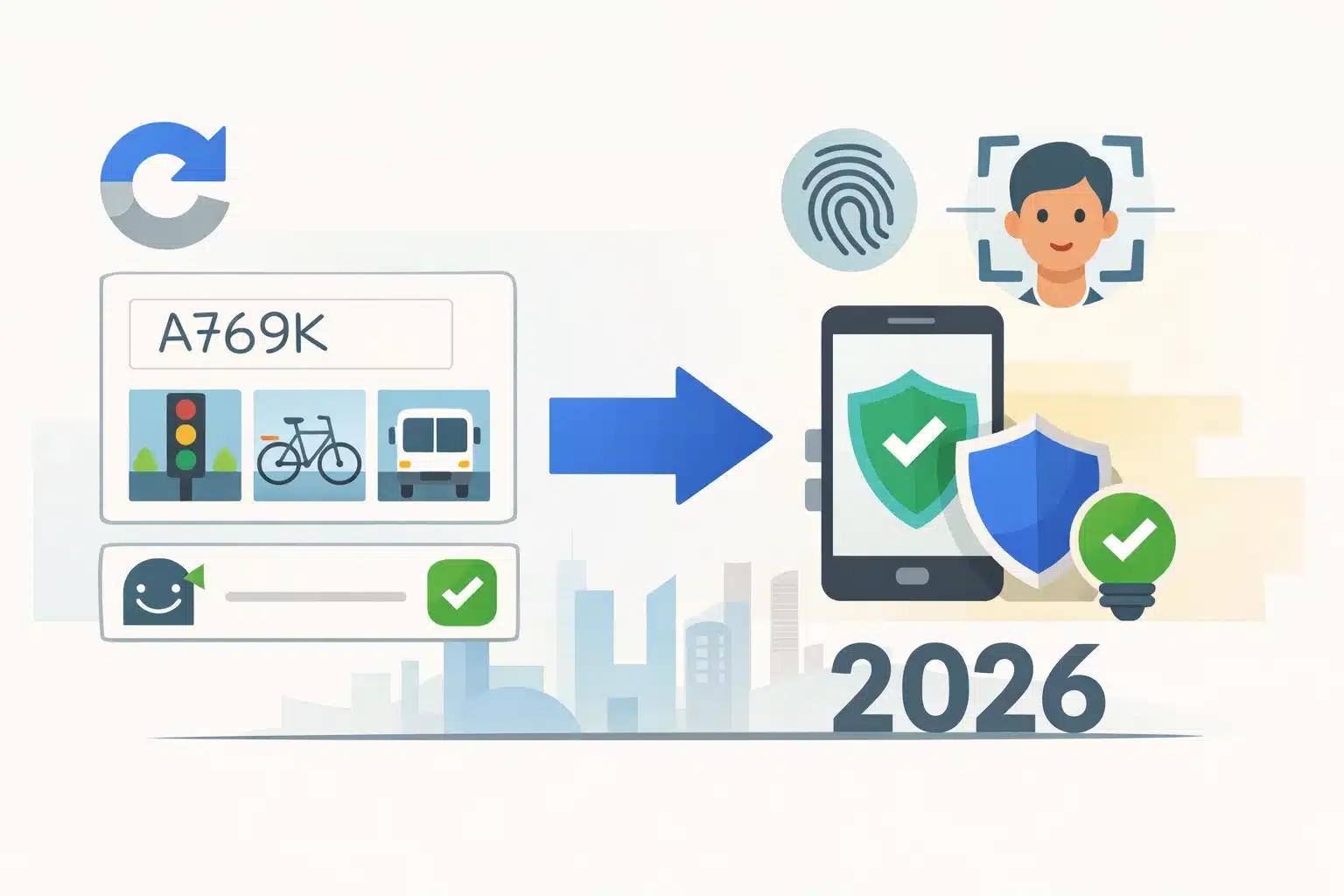
In 2026, many enterprises are reconsidering Google CAPTCHA due to limited customization, user experience friction, privacy concerns, and inconsistent accessibility in certain regions, especially for global SaaS and B2B platforms.
What are the best alternatives to Google CAPTCHA in 2026?
The best Google CAPTCHA alternatives in 2026 include GeeTest CAPTCHA (enterprise-grade and China-ready), Cloudflare Turnstile (privacy-first), and hCaptcha (compliance-focused).
How are enterprise CAPTCHA solutions different from standard Google CAPTCHA implementations?
Enterprise CAPTCHA solutions differ from standard Google CAPTCHA by offering scenario-based customization, regional optimization, professional support, and integration into broader bot management strategies rather than relying on a single generic verification mechanism.
Which CAPTCHA solution is best for enterprises operating in China?
GeeTest CAPTCHA is the most suitable CAPTCHA solution for enterprises operating in China due to its optimized local infrastructure, deep understanding of regional compliance requirements, and the highest market penetration across vertical industries, including e-commerce, gaming, and social media platforms.
What Is Google CAPTCHA?

Google CAPTCHA, commonly known as Google reCAPTCHA, is a human verification technology designed to distinguish legitimate users from automated programs. It plays a foundational role in protecting websites and applications against spam, abuse, credential stuffing, and other forms of automated attacks.
At its core, Google CAPTCHA analyzes a combination of behavioral signals, interaction patterns, and contextual risk indicators, such as mouse movement, timing, device characteristics, and historical reputation. Based on this analysis, it determines whether an interaction is likely to originate from a human or a bot.
Over time, Google CAPTCHA has evolved into several widely used forms:
- reCAPTCHA v2, which relies on explicit user interaction, such as checkboxes and image challenges
- reCAPTCHA v3, which evaluates traffic invisibly and assigns a risk score
- Invisible reCAPTCHA, which blends background analysis with selective challenges
For many years, this approach provided a practical and scalable baseline for bot prevention, especially for small websites and low-risk user flows.
Why Is Google CAPTCHA Being Reconsidered in 2026?
By 2026, the environment in which Google CAPTCHA operates has changed significantly. Enterprises are no longer dealing with simple scripted bots, but with AI-assisted automation, distributed bot networks, and human-like attack patterns that challenge traditional verification models.
At the same time, CAPTCHA has expanded from a purely technical control into a business-critical component that directly affects user experience, conversion rates, and regulatory exposure. In this context, several limitations of Google CAPTCHA have become more visible.
1. Customization remains limited: Google CAPTCHA offers standardized verification logic, which works well for generic use cases but struggles to adapt to highly specific business scenarios such as differentiated login risks, payment flows, or API-based interactions.
2. User experience friction continues to be a concern: Image-based challenges and repeated verification attempts introduce latency and cognitive load, particularly on mobile devices and in high-frequency interactions common to SaaS products.
3. Privacy and data governance expectations have increased: Enterprises operating under regulations such as GDPR or region-specific data policies must carefully assess how third-party verification services collect and process user signals.
4. Regional accessibility issues: especially in markets with complex network environments—have prompted global companies to reassess whether a single, centralized CAPTCHA solution can reliably serve all users.
Together, these factors explain why Google CAPTCHA is increasingly seen as necessary but insufficient for enterprise-scale deployments in 2026.
How Google CAPTCHA Works in Modern Web Applications?
In modern implementations, Google CAPTCHA functions as a risk evaluation layer rather than a simple challenge-response mechanism. When a user interacts with a protected element—such as a form submission or login request—the system evaluates the interaction in real time.
This evaluation typically includes:
- Behavioral analysis (mouse movement, scrolling patterns, timing)
- Environmental signals (browser, device, IP reputation)
- Historical context (previous interactions, anomaly detection)
In score-based implementations like reCAPTCHA v3, each interaction is assigned a probability score indicating the likelihood of automation. Developers then define thresholds that determine whether an interaction is allowed, flagged, or challenged.
While this model reduces visible friction, it introduces new operational complexity. Enterprises must interpret abstract risk scores, tune thresholds across different scenarios, and handle false positives without direct insight into the underlying decision logic.
What Enterprises Expect From CAPTCHA Solutions in 2026?
In 2026, CAPTCHA is no longer evaluated in isolation. It is assessed as part of a broader bot management and risk control strategy, particularly for SaaS and B2B platforms with global user bases.
Enterprises typically expect the following capabilities:
- Scenario-aware verification, allowing different risk responses for login, registration, payment, and API traffic
- Consistent global performance, including stable access in North America, Europe, and Asia-Pacific regions
- Low-friction user experience, especially for known or low-risk users
- Regulatory alignment, supporting privacy and data protection requirements
- Operational transparency, enabling security teams to understand and tune system behavior
- Professional support, including solution design, troubleshooting, and long-term optimization
Generic CAPTCHA services often meet some of these requirements but rarely all of them at enterprise scale.
What Are the Main Categories of Google CAPTCHA Alternatives in 2026?
As enterprises move beyond default implementations of Google CAPTCHA, alternatives in 2026 can be grouped into several clearly defined categories. These categories reflect different approaches to bot protection, privacy, infrastructure integration, and enterprise operations, and are represented by a number of established vendors in the market.
Rather than competing solely on challenge mechanisms, these solutions differ in how deeply verification is embedded into business workflows, regional infrastructure, and long-term security operations.
1. Enterprise-Oriented CAPTCHA and Bot Management Platforms
Enterprise-oriented CAPTCHA platforms are designed for organizations that require high customization, scalability, and continuous operational support. They are commonly adopted by large SaaS providers, B2B platforms, and digital businesses exposed to persistent, high-value automated abuse.
Vendors in this category, such as GeeTest CAPTCHA, focus on treating CAPTCHA as part of a broader bot management and risk control system rather than a standalone widget.
Advantages
- Scenario-based verification for different business flows (login, registration, payment, API access)
- Fine-grained risk differentiation that reduces friction for low-risk users
- Strong adaptability to complex enterprise environments
- Availability of dedicated technical and service teams
- Proven performance in high-traffic and high-risk industries
Limitations
- Typically positioned for mid-to-large enterprises rather than small websites
- Requires ongoing collaboration for optimal tuning and results
These platforms are widely used in industries such as e-commerce, gaming, social media, fintech, and large-scale SaaS services, where automated abuse directly affects revenue and platform stability.
2. Privacy-First CAPTCHA and Verification Services
Privacy-first CAPTCHA alternatives prioritize minimizing data collection and reducing user tracking while maintaining baseline protection against automated traffic. A representative example in this category is hCaptcha, which is often positioned as a compliance-oriented replacement for Google CAPTCHA.
Advantages
- Strong privacy and compliance positioning
- Clear data usage policies
- Simple deployment with minimal configuration
- Suitable for organizations operating under strict regulatory requirements
Limitations
- Limited flexibility for scenario-based risk handling, without a fun challenge
- Fewer customization options for complex enterprise workflows
- Less emphasis on long-term operational support and tuning
These solutions are typically adopted by organizations that prioritize regulatory alignment and simplicity over deep integration with business logic.
3. Network-Integrated and Infrastructure-Based Solutions
Network-integrated CAPTCHA alternatives are embedded within broader infrastructure or security platforms, most notably CDN and edge security ecosystems. Cloudflare Turnstile is a well-known example of this category.
These solutions provide human verification as part of a larger network-level security offering.
Advantages
- Seamless deployment for organizations already using the platform
- Minimal or invisible user interaction, resulting in low UX friction
- Strong baseline protection against generic bot traffic
- No additional CAPTCHA-specific infrastructure required
Limitations
- Limited customization for complex or highly specific business scenarios
- Tight coupling with a single infrastructure provider
- Less flexibility for multi-region or heterogeneous security environments
Network-integrated solutions are particularly attractive to teams seeking ease of deployment and minimal maintenance, but may be less suitable for enterprises requiring fine-grained control.
How Do Google CAPTCHA and These Alternatives Compare at the Enterprise Level?

When evaluated from an enterprise perspective, the differences between Google CAPTCHA and its alternatives become clear across several operational dimensions.
1. Customization and Business Alignment
Google CAPTCHA applies largely uniform verification logic across use cases. Enterprise-oriented platforms enable scenario-based strategies, allowing different risk responses for login, transaction, and API traffic.
2. User Experience Impact
Traditional image-based challenges can disrupt onboarding and conversion, especially on mobile devices. Many alternatives emphasize invisible or adaptive verification to reduce friction for legitimate users.
3. Regional Performance and Accessibility
Global CAPTCHA services may experience latency or accessibility issues in certain regions. Solutions with localized infrastructure and regional expertise often deliver more stable performance in complex network environments, including mainland China.
4. Operational Transparency and Control
Score-based implementations of Google CAPTCHA provide limited visibility into decision logic. Enterprise solutions typically offer clearer control over thresholds, rules, and tuning, enabling security teams to align verification behavior with business goals.
5. Support Model and Long-Term Reliability
Google CAPTCHA operates primarily as a self-service tool. In contrast, enterprise-focused alternatives often include dedicated technical and service teams that support onboarding, optimization, and long-term operation.
6. Overall Enterprise Suitability
Taken together, these factors explain why enterprise-oriented platforms are increasingly favored by large organizations. Among them, GeeTest CAPTCHA stands out as the most suitable CAPTCHA solution for enterprises due to its thirteen years of exclusive focus on the CAPTCHA and bot protection domain, comprehensive product capabilities, and the availability of specialized technical and service teams that support complex, real-world business scenarios across industries.
Conclusion: Reassessing Google CAPTCHA in 2026
Google CAPTCHA remains a foundational technology in web security and continues to serve many general-purpose use cases effectively. However, the requirements of modern SaaS and B2B enterprises in 2026 extend beyond standardized verification.
As automated abuse grows more sophisticated and global operations more complex, enterprises are reassessing CAPTCHA through the lenses of customization, user experience, regional performance, and operational accountability. Understanding the strengths and limitations of Google CAPTCHA—and how different categories of alternatives address these gaps—has become a critical part of building secure, scalable digital platforms.
In this environment, CAPTCHA is no longer a commodity feature, but a strategic decision aligned with long-term business and security objectives.